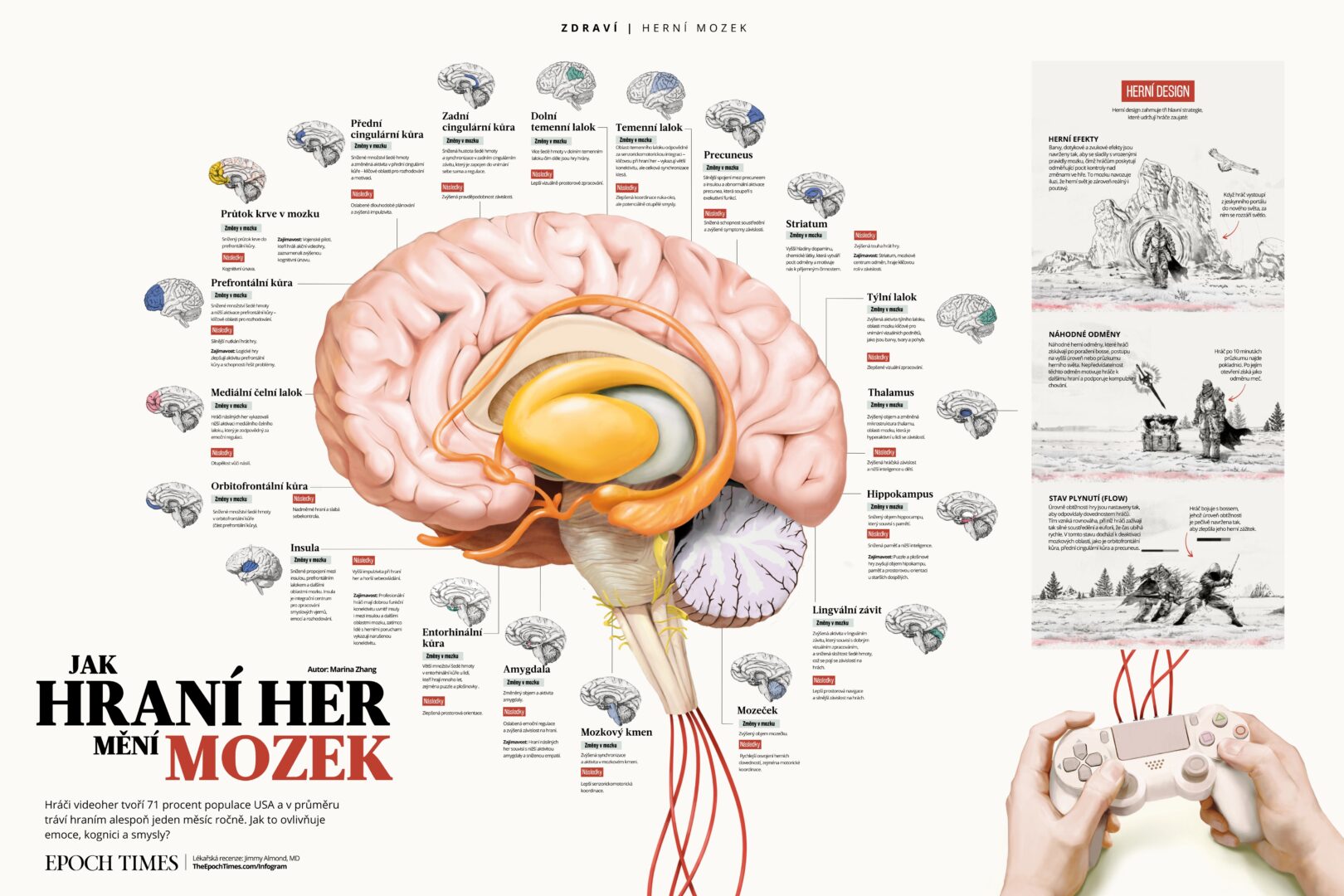
Hráči videoher tvoří 71 procent populace USA a v průměru tráví hraním alespoň jeden měsíc ročně. Jak to ovlivňuje emoce, kognici a smysly?
V České republice hraje videohry přibližně třetina populace ve věku 16–74 let. Nejčastěji se jedná o mladé lidi do 24 let, kde dosahuje podíl hráčů až 68 %. U starších věkových skupin zájem klesá, u seniorů se pohybuje kolem 3 %. Průměrně tráví hráči u videoher 6–7 hodin týdně, ale například vášniví online hráči, zejména mladí dospělí, se mohou pohybovat v rozmezí desítek hodin týdně.
Výzkumy napříč světem ukazují, že dopad hraní her na mozek není jednoznačný. Hry mohou posilovat pozornost, prostorové vnímání a rychlost reakce, především u mladších hráčů. Studie ale zároveň upozorňují, že nadměrné hraní – zvlášť u dětí a dospívajících – může negativně ovlivňovat regulaci emocí, spánek a schopnost soustředění. Vliv závisí na typu her, délce hraní i věku hráče.
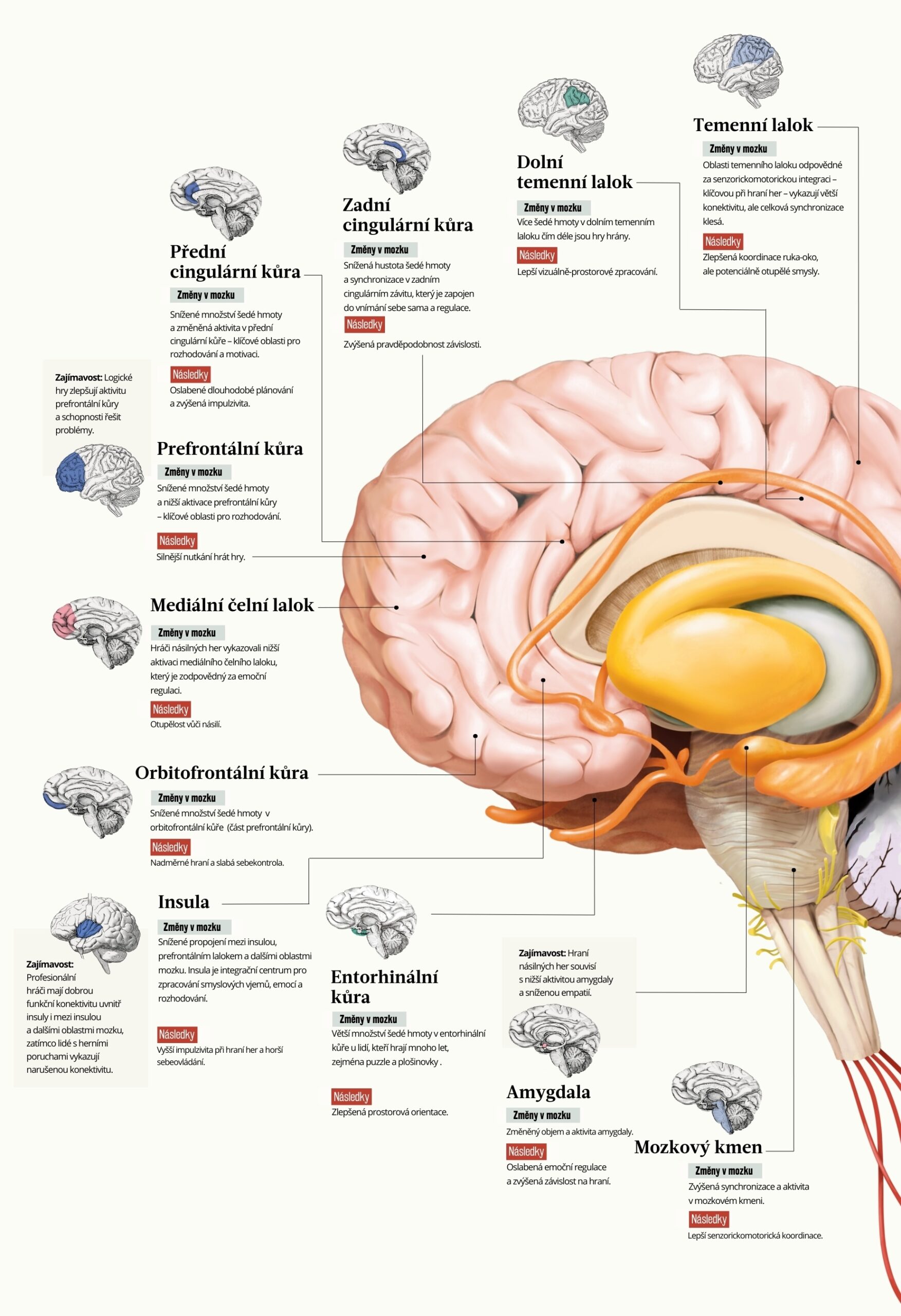
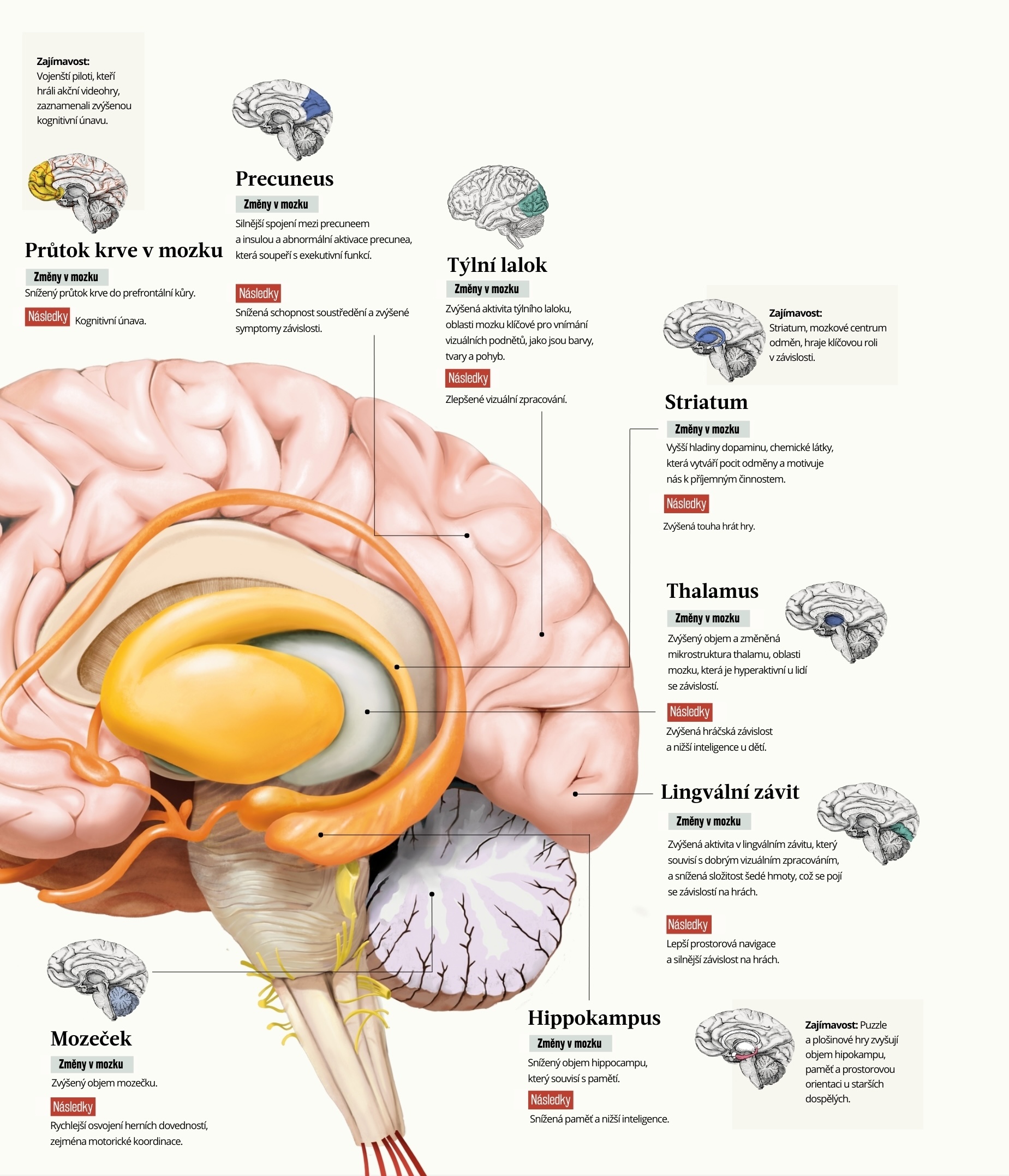
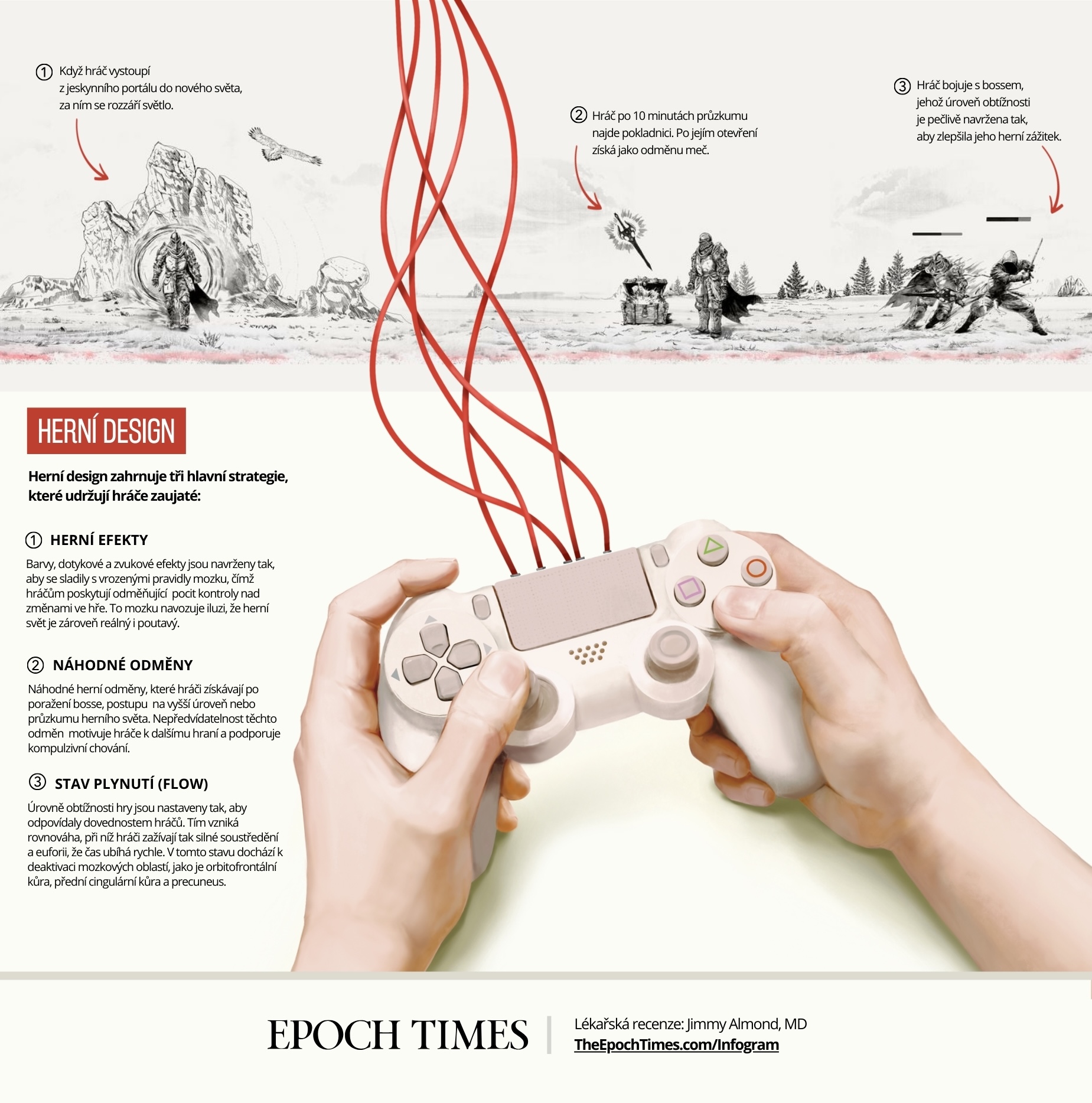
Jak herní design ovlivňuje mozek hráče? Interaktivní prvky, rychlé rozhodování i „odměňovací smyčky“ zasahují hluboko do zpracování emocí, motivace a paměti. V infografice najdete přehled konkrétních mozkových oblastí, na které má hraní vliv – a jaký.

Zdroje:
Bailey, K., West, R., & Anderson, C. A. (2010). A negative association between video game
experience and proactive cognitive control. Psychophysiology, 47(1), 34–42.
https://doi.org/10.1111/j.1469-8986.2009.00925.x
Bediou, B., Adams, D. M., Mayer, R. E., Tipton, E., Green, C. S., & Bavelier, D. (2018). Meta-
analysis of action video game impact on perceptual, attentional, and cognitive skills.
Psychological Bulletin, 144(1), 77–110. https://doi.org/10.1037/bul0000130
Brilliant T., D., Nouchi, R., & Kawashima, R. (2019). Does Video Gaming Have Impacts on the
Brain: Evidence from a Systematic Review. Brain Sciences, 9(10), Article 251.
https://doi.org/10.3390/brainsci9100251
Chen, C.-Y., Yen, J.-Y., Wang, P.-W., Liu, G.-C., Yen, C.-F., & Ko, C.-H. (2016). Altered Functional
Connectivity of the Insula and Nucleus Accumbens in Internet Gaming Disorder: A
Resting State fMRI Study. European Addiction Research, 22(4), 192–200.
https://doi.org/10.1159/000440716
Choi, E., Shin, S.-H., Ryu, J.-K., Jung, K.-I., Hyun, Y., Kim, J., & Park, M.-H. (2021a). Association of
Extensive Video Gaming and Cognitive Function Changes in Brain-Imaging Studies of
Pro Gamers and Individuals With Gaming Disorder: Systematic Literature Review. JMIR
Serious Games, 9(3), e25793. https://doi.org/10.2196/25793
Choi, E., Shin, S.-H., Ryu, J.-K., Jung, K.-I., Hyun, Y., Kim, J., & Park, M.-H. (2021b). Association of
Extensive Video Gaming and Cognitive Function Changes in Brain-Imaging Studies of
Pro Gamers and Individuals With Gaming Disorder: Systematic Literature Review. JMIR
Serious Games, 9(3), Article e25793. https://doi.org/10.2196/25793
Chou, Y.-H., Yang, B.-H., Hsu, J.-W., Wang, S.-J., Lin, C.-L., Huang, K.-L., Chien Chang, A., & Lee, S.-
M. (2012). Effects of video game playing on cerebral blood flow in young adults: A SPECT
study. Psychiatry Research: Neuroimaging, 212(1), 65–72.
https://doi.org/10.1016/j.pscychresns.2012.10.002
Daniels, J. K., McFarlane, A. C., Bluhm, R. L., Moores, K. A., Clark, C. R., Shaw, M. E., Williamson,
P. C., Densmore, M., & Lanius, R. A. (2010). Switching between executive and default
mode networks in posttraumatic stress disorder: alterations in functional connectivity.
Journal of Psychiatry & Neuroscience : JPN, 35(4), 258–266.
https://doi.org/10.1503/jpn.090175
de Sampaio Barros, M. F., Araújo-Moreira, F. M., Trevelin, L. C., & Radel, R. (2018). Flow
experience and the mobilization of attentional resources. Cognitive, Affective, &
Behavioral Neuroscience, 18(4), 810–823. https://doi.org/10.3758/s13415-018-0606-4
Ding, W., Sun, J., Sun, Y., Zhou, Y., Li, L., Xu, J., & Du, Y. (2013a). Altered Default Network
Resting-State Functional Connectivity in Adolescents with Internet Gaming Addiction.
PLoS ONE, 8(3), e59902. https://doi.org/10.1371/journal.pone.0059902
Ding, W., Sun, J., Sun, Y., Zhou, Y., Li, L., Xu, J., & Du, Y. (2013b). Altered Default Network
Resting-State Functional Connectivity in Adolescents with Internet Gaming Addiction.
PLoS ONE, 8(3), Article e59902. https://doi.org/10.1371/journal.pone.0059902
Dom, G., Sabbe, B., Hulstijn, W., & van den Brink, W. (2005). Substance use disorders and the
orbitofrontal cortex: Systematic review of behavioural decision-making and
neuroimaging studies. The British Journal of Psychiatry, 187(3), 209–220.
https://doi.org/10.1192/bjp.187.3.209
Dong, G., Huang, J., & Du, X. (2012a). Alterations in regional homogeneity of resting-state brain
activity in internet gaming addicts. Behavioral and Brain Functions, 8(1), 41.
https://doi.org/10.1186/1744-9081-8-41
Dong, G., Huang, J., & Du, X. (2012b). Alterations in regional homogeneity of resting-state brain
activity in internet gaming addicts. Behavioral and Brain Functions, 8(1), 41.
https://doi.org/10.1186/1744-9081-8-41
Dong, G.-H., Wang, M., Wang, Z., Zheng, H., Du, X., & Potenza, M. N. (2020). Addiction severity
modulates the precuneus involvement in internet gaming disorder: Functionality,
morphology and effective connectivity. Progress in Neuro-Psychopharmacology and
Biological Psychiatry, 98, 109829. https://doi.org/10.1016/j.pnpbp.2019.109829
Fransson, P., & Marrelec, G. (2008). The precuneus/posterior cingulate cortex plays a pivotal
role in the default mode network: Evidence from a partial correlation network analysis.
NeuroImage, 42(3), 1178–1184. https://doi.org/10.1016/j.neuroimage.2008.05.059
Granek, J. A., Gorbet, D. J., & Sergio, L. E. (2009). Extensive video-game experience alters
cortical networks for complex visuomotor transformations. Cortex, 46(9), 1165–1177.
https://doi.org/10.1016/j.cortex.2009.10.009
Green, C. S., & Bavelier, D. (2006). Effect of action video games on the spatial distribution of
visuospatial attention. Journal of Experimental Psychology: Human Perception and
Performance, 32(6), 1465–1478. https://doi.org/10.1037/0096-1523.32.6.1465
Haier, R. J., Karama, S., Leyba, L., & Jung, R. E. (2009). MRI assessment of cortical thickness and
functional activity changes in adolescent girls following three months of practice on a
visual-spatial task. BMC Research Notes, 2(1), Article 174.
https://doi.org/10.1186/1756-0500-2-174
Han, D. H., Lyoo, I. K., & Renshaw, P. F. (2012). Differential regional gray matter volumes in
patients with on-line game addiction and professional gamers. Journal of Psychiatric
Research, 46(4), 507–515. https://doi.org/10.1016/j.jpsychires.2012.01.004
Hou, H.-Y., Jia, X.-Z., Wang, P., Zhang, J.-X., Huang, S., & Li, H.-J. (2019a). Intrinsic Resting-State
Activity in Older Adults With Video Game Experience. Frontiers in Aging Neuroscience,
11, Article 119. https://doi.org/10.3389/fnagi.2019.00119
Hou, H.-Y., Jia, X.-Z., Wang, P., Zhang, J.-X., Huang, S., & Li, H.-J. (2019b). Intrinsic Resting-State
Activity in Older Adults With Video Game Experience. Frontiers in Aging Neuroscience,
11, Article 119. https://doi.org/10.3389/fnagi.2019.00119
Huang, H., & Cheng, C. (2022). The Benefits of Video Games on Brain Cognitive Function: A
Systematic Review of Functional Magnetic Resonance Imaging Studies. Applied Sciences,
12(11), Article 5561. https://doi.org/10.3390/app12115561
Hull, D. C., Williams, G. A., & Griffiths, M. D. (2013). Video game characteristics, happiness and
flow as predictors of addiction among video game players: A pilot study. Journal of
Behavioral Addictions, 2(3), 145–152. https://doi.org/10.1556/jba.2.2013.005
Kalnin, A. J., Edwards, C. R., Wang, Y., Kronenberger, W. G., Hummer, T. A., Mosier, K. M., Dunn,
D. W., & Mathews, V. P. (2011). The interacting role of media violence exposure and
aggressive–disruptive behavior in adolescent brain activation during an emotional
Stroop task. Psychiatry Research: Neuroimaging, 192(1), 12–19.
https://doi.org/10.1016/j.pscychresns.2010.11.005
Kanokporn Leelartapin, Warong Lapanun, Sakesan Kantha, Tanaka, H., & Daroonwan Suksom.
(2023a). Cognitive Fatigue in Habitual Video Gamers and Non-gamers among Military
Pilots in Training. Physical Activity and Health, 7(1), 319–331.
https://doi.org/10.5334/paah.298
Kanokporn Leelartapin, Warong Lapanun, Sakesan Kantha, Tanaka, H., & Daroonwan Suksom.
(2023b). Cognitive Fatigue in Habitual Video Gamers and Non-gamers among Military
Pilots in Training. Physical Activity and Health, 7(1), 319–331.
https://doi.org/10.5334/paah.298
Kanokporn Leelartapin, Warong Lapanun, Sakesan Kantha, Tanaka, H., & Daroonwan Suksom.
(2023c). Cognitive Fatigue in Habitual Video Gamers and Non-gamers among Military
Pilots in Training. Physical Activity and Health, 7(1), 319–331.
https://doi.org/10.5334/paah.298
Kao, D. (2020). The effects of juiciness in an action RPG. Entertainment Computing, 34, Article
100359. https://doi.org/10.1016/j.entcom.2020.100359
Kawaike, Y., Nagata, J., Furuya, T., Koriyama, C., Nakamura, M., & Sano, A. (2019a). Working
Memory-Related Prefrontal Hemodynamic Responses in University Students: A
Correlation Study of Subjective Well-Being and Lifestyle Habits. Frontiers in Behavioral
Neuroscience, 13, Article 213. https://doi.org/10.3389/fnbeh.2019.00213
Kawaike, Y., Nagata, J., Furuya, T., Koriyama, C., Nakamura, M., & Sano, A. (2019b). Working
Memory-Related Prefrontal Hemodynamic Responses in University Students: A
Correlation Study of Subjective Well-Being and Lifestyle Habits. Frontiers in Behavioral
Neuroscience, 13(9). Article 213. https://doi.org/10.3389/fnbeh.2019.00213
Kim, J.-Y., Chun, J.-W., Park, C.-H., Cho, H., Choi, J., Yang, S., Ahn, K.-J., & Kim, D. J. (2019a). The
Correlation between the Frontostriatal Network and Impulsivity in Internet Gaming
Disorder. Scientific Reports, 9(1), 1191. https://doi.org/10.1038/s41598-018-37702-4
Kim, J.-Y., Chun, J.-W., Park, C.-H., Cho, H., Choi, J., Yang, S., Ahn, K.-J., & Kim, D. J. (2019b). The
Correlation between the Frontostriatal Network and Impulsivity in Internet Gaming
Disorder. Scientific Reports, 9(1). Article 1191. https://doi.org/10.1038/s41598-018-37702-4
Kim, S.-J., Kim, M.-K., Shin, Y.-B., Kim, H. E., Kwon, J. H., & Kim, J.-J. (2021). Differences in resting-
state functional connectivity according to the level of impulsiveness in patients with
internet gaming disorder. Journal of Behavioral Addictions, 10(1), 88–98.
https://doi.org/10.1556/2006.2021.00005
Klasen, M., Weber, R., Kircher, T. T. J., Mathiak, K. A., & Mathiak, K. (2011). Neural contributions
to flow experience during video game playing. Social Cognitive and Affective
Neuroscience, 7(4), 485–495. https://doi.org/10.1093/scan/nsr021
Koepp, M. J., Gunn, R. N., Lawrence, A. D., Cunningham, V. J., Dagher, A., Jones, T., Brooks, D. J.,
Bench, C. J., & Grasby, P. M. (1998). Evidence for striatal dopamine release during a video
game. Nature, 393(6682), 266–268. https://doi.org/10.1038/30498
Kowalczyk, N., Shi, F., Mikołaj Magnuski, Maciek Skorko, Dobrowolski, P., Bartosz Kossowski,
Marchewka, A., Bielecki, M., Małgorzata Kossut, & Aneta Brzezicka. (2018). Real‐time
strategy video game experience and structural connectivity – A diffusion tensor imaging
study. Human Brain Mapping, 39(9), 3742–3758. https://doi.org/10.1002/hbm.24208
Kress, S., Neudorf, J., Borowsky, B., & Borowsky, R. (2022). What’s in a game: Video game visual-
spatial demand location exhibits a double dissociation with reading speed. Acta
Psychologica, 232, 103822. https://doi.org/10.1016/j.actpsy.2022.103822
Kühn, S., & Gallinat, J. (2013a). Amount of lifetime video gaming is positively associated with
entorhinal, hippocampal and occipital volume. Molecular Psychiatry, 19(7), 842–847.
https://doi.org/10.1038/mp.2013.100
Kühn, S., & Gallinat, J. (2013b). Amount of lifetime video gaming is positively associated with
entorhinal, hippocampal and occipital volume. Molecular Psychiatry, 19(7), 842–847.
https://doi.org/10.1038/mp.2013.100
Kühn, S., Gallinat, J., & Mascherek, A. (2019). Effects of computer gaming on cognition, brain
structure, and function: a critical reflection on existing literature. Dialogues in Clinical
Neuroscience, 21(3), 319–330. https://doi.org/10.31887/dcns.2019.21.3/skuehn
Kühn, S., Gleich, T., Lorenz, R. C., Lindenberger, U., & Gallinat, J. (2013). Playing Super Mario
induces structural brain plasticity: gray matter changes resulting from training with a
commercial video game. Molecular Psychiatry, 19(2), 265–271.
https://doi.org/10.1038/mp.2013.120
Kwak, K. H., Hwang, H. C., Kim, S. M., & Han, D. H. (2020a). Comparison of Behavioral Changes
and Brain Activity between Adolescents with Internet Gaming Disorder and Student Pro-
Gamers. International Journal of Environmental Research and Public Health, 17(2), 441.
https://doi.org/10.3390/ijerph17020441
Kwak, K. H., Hwang, H. C., Kim, S. M., & Han, D. H. (2020b). Comparison of Behavioral Changes and Brain
Activity between Adolescents with Internet Gaming Disorder and Student Pro-Gamers.
International Journal of Environmental Research and Public Health, 17(2), Article 441.
https://doi.org/10.3390/ijerph17020441
Lai, C., Pellicano, G. R., Altavilla, D., Proietti, A., Lucarelli, G., Massaro, G., Luciani, M., & Aceto, P.
(2018). Violence in video game produces a lower activation of limbic and temporal areas in
response to social inclusion images. Cognitive, Affective, & Behavioral Neuroscience, 19(4), 898–
909. https://doi.org/10.3758/s13415-018-00683-y
Lin, X., Dong, G., Wang, Q., & Du, X. (2014). Abnormal gray matter and white matter volume in “Internet
gaming addicts.” Addictive Behaviors, 40, 137–143.
https://doi.org/10.1016/j.addbeh.2014.09.010
Lin, X., Dong, G., Wang, Q., & Du, X. (2015). Abnormal gray matter and white matter volume in “Internet
gaming addicts.” Addictive Behaviors, 40, 137–143. https://doi.org/10.1016/j.addbeh.2014.09.010
Liu, G.-C., Yen, J.-Y., Chen, C.-Y., Yen, C.-F., Chen, C.-S., Lin, W.-C., & Ko, C.-H. (2013). Brain activation for
response inhibition under gaming cue distraction in internet gaming disorder. The Kaohsiung
Journal of Medical Sciences, 30(1), 43–51. https://doi.org/10.1016/j.kjms.2013.08.005
Liu, G.-C., Yen, J.-Y., Chen, C.-Y., Yen, C.-F., Chen, C.-S., Lin, W.-C., & Ko, C.-H. (2014). Brain activation for
response inhibition under gaming cue distraction in internet gaming disorder. The Kaohsiung
Journal of Medical Sciences, 30(1), 43–51. https://doi.org/10.1016/j.kjms.2013.08.005
Liu, L., Yao, Y.-W., Li, C. R., Zhang, J.-T., Xia, C.-C., Lan, J., Ma, S.-S., Zhou, N., & Fang, X.-Y. (2018). The
Comorbidity Between Internet Gaming Disorder and Depression: Interrelationship and Neural
Mechanisms. Frontiers in Psychiatry, 9, Article 154. https://doi.org/10.3389/fpsyt.2018.00154
Liu, L., Yip, S. W., Zhang, J.-T., Wang, L.-J., Shen, Z.-J., Liu, B., Ma, S.-S., Yao, Y.-W., & Fang, X.-Y. (2016).
Activation of the ventral and dorsal striatum during cue reactivity in Internet gaming disorder.
Addiction Biology, 22(3), 791–801. https://doi.org/10.1111/adb.12338
Luijten, M., Meerkerk, G.-J., Franken, I. H. A., van de Wetering, B. J. M., & Schoenmakers, T. M. (2015). An
fMRI study of cognitive control in problem gamers. Psychiatry Research: Neuroimaging, 231(3),
262–268. https://doi.org/10.1016/j.pscychresns.2015.01.004
Mancone, S., Tosti, B., Corrado, S., & Diotaiuti, P. (2024). Effects of video game immersion and task
interference on cognitive performance: a study on immediate and delayed recall and recognition
accuracy. PeerJ, 12, e18195. Article e18195. https://doi.org/10.7717/peerj.18195
Martínez, K., Solana, A. B., Burgaleta, M., Hernández-Tamames, J. A., Álvarez-Linera, J., Román, F. J.,
Alfayate, E., Privado, J., Escorial, S., Quiroga, M. A., Karama, S., Bellec, P., & Colom, R. (2012).
Changes in resting-state functionally connected parietofrontal networks after videogame practice.
Human Brain Mapping, 34(12), 3143–3157. https://doi.org/10.1002/hbm.22129
Mathiak, K., & Weber, R. (2006). Toward brain correlates of natural behavior: fMRI during violent video
games. Human Brain Mapping, 27(12), 948–956. https://doi.org/10.1002/hbm.20234
Mihaly Csikszentmihalyi. (2004, February). Flow, the secret to happiness. Ted.com; TED Talks.
https://www.ted.com/talks/mihaly_csikszentmihalyi_flow_the_secret_to_happiness
Mohammadi, B., Szycik, G. R., te Wildt, B., Heldmann, M., Samii, A., & Münte, T. F. (2020). Structural brain
changes in young males addicted to video-gaming. Brain and Cognition, 139, Article 105518.
https://doi.org/10.1016/j.bandc.2020.105518
Momi, D., Smeralda, C. L., Di Lorenzo, G., Neri, F., Rossi, S., Rossi, A., & Santarnecchi, E. (2020). Long-
lasting connectivity changes induced by intensive first-person shooter gaming. Brain Imaging and
Behavior, 15(3), 1518–1532. https://doi.org/10.1007/s11682-020-00350-2
Montag, C., Weber, B., Trautner, P., Newport, B., Markett, S., Walter, N. T., Felten, A., & Reuter, M. (2011).
Does excessive play of violent first-person-shooter-video-games dampen brain activity in response
to emotional stimuli? Biological Psychology, 89(1), 107–111.
https://doi.org/10.1016/j.biopsycho.2011.09.014
Montag, C., Weber, B., Trautner, P., Newport, B., Markett, S., Walter, N. T., Felten, A., & Reuter, M. (2012).
Does excessive play of violent first-person-shooter-video-games dampen brain activity in response
to emotional stimuli? Biological Psychology, 89(1), 107–111.
https://doi.org/10.1016/j.biopsycho.2011.09.014
Mundorf, A., Siebert, A., Desmond, J. E., & Peterburs, J. (2023). The role of the cerebellum in internet
gaming disorder—A systematic review. Addiction Biology, 28(10), Article 13331.
https://doi.org/10.1111/adb.13331
Nikolaidis, A., Voss, M. W., Lee, H., Vo, L. T. K., & Kramer, A. F. (2014). Parietal plasticity after training
with a complex video game is associated with individual differences in improvements in an
untrained working memory task. Frontiers in Human Neuroscience, 8, Article 169.
https://doi.org/10.3389/fnhum.2014.00169
Nouchi, R., Kawata, N. Y. dos S., Saito, T., Himmelmeier, R. M., Nakamura, R., Nouchi, H., & Kawashima, R.
(2020). Dorsolateral Prefrontal Cortex Activity during a Brain Training Game Predicts Cognitive
Improvements after Four Weeks’ Brain Training Game Intervention: Evidence from a Randomized
Controlled Trial. Brain Sciences, 10(8), 560. https://doi.org/10.3390/brainsci10080560
Obana, T., & Kozhevnikov, M. (2012). State effects of action video-game playing on visuospatial processing
efficiency and attention among experienced action video-game players. Proceedings of the Annual
Meeting of the Cognitive Science Society, 34. https://escholarship.org/uc/item/7108h8b4
Palaus, M., Marron, E. M., Viejo-Sobera, R., & Redolar-Ripoll, D. (2017). Neural Basis of Video Gaming: A
Systematic Review. Frontiers in Human Neuroscience, 11, Article 248.
https://doi.org/10.3389/fnhum.2017.00248
Peracchia, S., & Curcio, G. (2018). Exposure to video games: effects on sleep and on post-sleep cognitive
abilities. A sistematic review of experimental evidences. Sleep Science, 11(4), 302–314.
https://doi.org/10.5935/1984-0063.20180046
Salminen, M., & Ravaja, N. (2008). Increased oscillatory theta activation evoked by violent digital game
events. Neuroscience Letters, 435(1), 69–72. https://doi.org/10.1016/j.neulet.2008.02.009
Smith, V., Mitchell, D. J., & Duncan, J. (2018). Role of the Default Mode Network in Cognitive Transitions.
Cerebral Cortex, 28(10), 3685–3696. https://doi.org/10.1093/cercor/bhy167
Sun, Y., Sun, J., Zhou, Y., Ding, W., Chen, X., Zhuang, Z., Xu, J., & Du, Y. (2014a). Assessment of in vivo
microstructure alterations in gray matter using DKI in internet gaming addiction. Behavioral and
Brain Functions, 10(1), Article 37. https://doi.org/10.1186/1744-9081-10-37
Sun, Y., Sun, J., Zhou, Y., Ding, W., Chen, X., Zhuang, Z., Xu, J., & Du, Y. (2014b). Assessment of in vivo
microstructure alterations in gray matter using DKI in internet gaming addiction. Behavioral and
Brain Functions, 10(1), 37. https://doi.org/10.1186/1744-9081-10-37
Swink, S. (2017). Game feel : a game designer’s guide to virtual sensation. CRC Press,
Taylor & Francis Group.
Tachibana, A., Noah, J. A., Bronner, S., Ono, Y., & Onozuka, M. (2011). Parietal and temporal activity during
a multimodal dance video game: An fNIRS study. Neuroscience Letters, 503(2), 125–130.
https://doi.org/10.1016/j.neulet.2011.08.023
Takeuchi, H., Taki, Y., Hashizume, H., Asano, K., Asano, M., Sassa, Y., Yokota, S., Kotozaki, Y., Nouchi, R., &
Kawashima, R. (2016a). Impact of videogame play on the brain’s microstructural properties: cross-
sectional and longitudinal analyses. Molecular Psychiatry, 21(12), 1781–1789.
https://doi.org/10.1038/mp.2015.193
Takeuchi, H., Taki, Y., Hashizume, H., Asano, K., Asano, M., Sassa, Y., Yokota, S., Kotozaki, Y., Nouchi, R., &
Kawashima, R. (2016b). Impact of videogame play on the brain’s microstructural properties: cross-
sectional and longitudinal analyses. Molecular Psychiatry, 21(12), 1781–1789.
https://doi.org/10.1038/mp.2015.193
Toril, P., Reales, J. M., Mayas, J., & Ballesteros, S. (2016). Video Game Training Enhances Visuospatial
Working Memory and Episodic Memory in Older Adults. Frontiers in Human Neuroscience, 10,
Article 206. https://doi.org/10.3389/fnhum.2016.00206
Uddin, L. Q., Nomi, J. S., Hébert-Seropian, B., Ghaziri, J., & Boucher, O. (2017). Structure and Function of
the Human Insula. Journal of Clinical Neurophysiology, 34(4), 300–306.
https://doi.org/10.1097/wnp.0000000000000377
Valls-Serrano, C., De Francisco, C., Vélez-Coto, M., & Caracuel, A. (2022). Visuospatial working memory and
attention control make the difference between experts, regulars and non-players of the videogame
League of Legends. Frontiers in Human Neuroscience, 16, Article 933331.
https://doi.org/10.3389/fnhum.2022.933331
Villalba-García, C., Griffiths, M. D., Demetrovics, Z., & Czakó, A. (2025). The relationship between loot box
buying, gambling, internet gaming, and mental health: Investigating the moderating effect of
impulsivity, depression, anxiety, and stress. Computers in Human Behavior, 166, Article 108579.
https://doi.org/10.1016/j.chb.2025.108579
Wang, L., Wu, L., Lin, X., Zhang, Y., Zhou, H., Du, X., & Dong, G. (2016). Altered brain functional networks
in people with Internet gaming disorder: Evidence from resting-state fMRI. Psychiatry Research:
Neuroimaging, 254, 156–163. https://doi.org/10.1016/j.pscychresns.2016.07.001
Wang, Y., Mathews, V. P., Kalnin, A. J., Mosier, K. M., Dunn, D. W., Saykin, A. J., & Kronenberger, W. G.
(2009). Short Term Exposure to a Violent Video Game Induces Changes in Frontolimbic Circuitry in
Adolescents. Brain Imaging and Behavior, 3(1), 38–50. https://doi.org/10.1007/s11682-008-9058-8
Waugh, C. E., Lemus, M. G., & Gotlib, I. H. (2014). The role of the medial frontal cortex in the maintenance
of emotional states. Social Cognitive and Affective Neuroscience, 9(12), 2001–2009.
https://doi.org/10.1093/scan/nsu011
Weinstein, A., & Lejoyeux, M. (2020). Neurobiological mechanisms underlying internet and gaming
disorder (IGD). Dialogues in Clinical Neuroscience, 22(2), 113–126.
https://doi.org/10.31887/dcns.2020.22.2/aweinstein
West, G. L., Konishi, K., Diarra, M., Benady-Chorney, J., Drisdelle, B. L., Dahmani, L., Sodums, D. J., Lepore,
F., Jolicoeur, P., & Bohbot, V. D. (2017). Impact of video games on plasticity of the hippocampus.
Molecular Psychiatry, 23(7), 1566–1574. https://doi.org/10.1038/mp.2017.155
West, G. L., Zendel, B. R., Konishi, K., Benady-Chorney, J., Bohbot, V. D., Peretz, I., & Belleville, S. (2017).
Playing Super Mario 64 increases hippocampal grey matter in older adults. PLOS ONE, 12(12),
Article e0187779. https://doi.org/10.1371/journal.pone.0187779
Woollett, K., Spiers, H. J., & Maguire, E. A. (2009). Talent in the taxi: a model system for exploring
expertise. Philosophical Transactions of the Royal Society B: Biological Sciences, 364(1522), 1407–
1416. https://doi.org/10.1098/rstb.2008.0288
Yoon, E. J., Choi, J.-S., Kim, H., Sohn, B. K., Jung, H. Y., Lee, J.-Y., Kim, D.-J., Park, S.-W., & Kim, Y. K. (2017).
Altered hippocampal volume and functional connectivity in males with Internet gaming disorder
comparing to those with alcohol use disorder. Scientific Reports, 7(1), Article 5744.
https://doi.org/10.1038/s41598-017-06057-7
Yuan, K., Cheng, P., Dong, T., Bi, Y., Xing, L., Yu, D., Zhao, L., Dong, M., von Deneen, K. M., Liu, Y., Qin, W., &
Tian, J. (2013). Cortical Thickness Abnormalities in Late Adolescence with Online Gaming
Addiction. PLoS ONE, 8(1), Article e53055. https://doi.org/10.1371/journal.pone.0053055
Zhang, J.-T., Yao, Y.-W., Li, C.-S. R., Zang, Y.-F., Shen, Z.-J., Liu, L., Wang, L.-J., Liu, B., & Fang, X.-Y. (2015a).
Altered resting-state functional connectivity of the insula in young adults with Internet gaming
disorder. Addiction Biology, 21(3), 743–751. https://doi.org/10.1111/adb.12247
Zhang, J.-T., Yao, Y.-W., Li, C.-S. R., Zang, Y.-F., Shen, Z.-J., Liu, L., Wang, L.-J., Liu, B., & Fang, X.-Y. (2015b).
Altered resting-state functional connectivity of the insula in young adults with Internet gaming
disorder. Addiction Biology, 21(3), 743–751. https://doi.org/10.1111/adb.12247
Zhang, P., Pan, Y., Rujing Zha, Song, H., Yuan, C., Zhao, Q., Piao, Y., Ren, J., Chen, Y., Liang, P., Tao, R., Wei,
Z., & Zhang, X. (2023). Impulsivity-related right superior frontal gyrus as a biomarker of internet
gaming disorder. General Psychiatry, 36(4), e100985–e100985.
https://doi.org/10.1136/gpsych-2022-100985
Zhang, Y., Mei, W., Zhang, J. X., Wu, Q., & Zhang, W. (2016a). Decreased functional connectivity of insula-
based network in young adults with internet gaming disorder. Experimental Brain Research,
234(9), 2553–2560. https://doi.org/10.1007/s00221-016-4659-8
Zhang, Y., Mei, W., Zhang, J. X., Wu, Q., & Zhang, W. (2016b). Decreased functional connectivity of insula-
based network in young adults with internet gaming disorder. Experimental Brain Research,
234(9), 2553–2560. https://doi.org/10.1007/s00221-016-4659-8
Zhou, F., Montag, C., Sariyska, R., Lachmann, B., Reuter, M., Weber, B., Trautner, P., Kendrick, K. M.,
Markett, S., & Becker, B. (2017a). Orbitofrontal gray matter deficits as marker of Internet gaming
disorder: converging evidence from a cross-sectional and prospective longitudinal design.
Addiction Biology, 24(1), 100–109. https://doi.org/10.1111/adb.12570
Zhou, F., Montag, C., Sariyska, R., Lachmann, B., Reuter, M., Weber, B., Trautner, P., Kendrick, K. M.,
Markett, S., & Becker, B. (2017b). Orbitofrontal gray matter deficits as marker of Internet gaming
disorder: converging evidence from a cross-sectional and prospective longitudinal design.
Addiction Biology, 24(1), 100–109. https://doi.org/10.1111/adb.12570
–ete–